Abstract
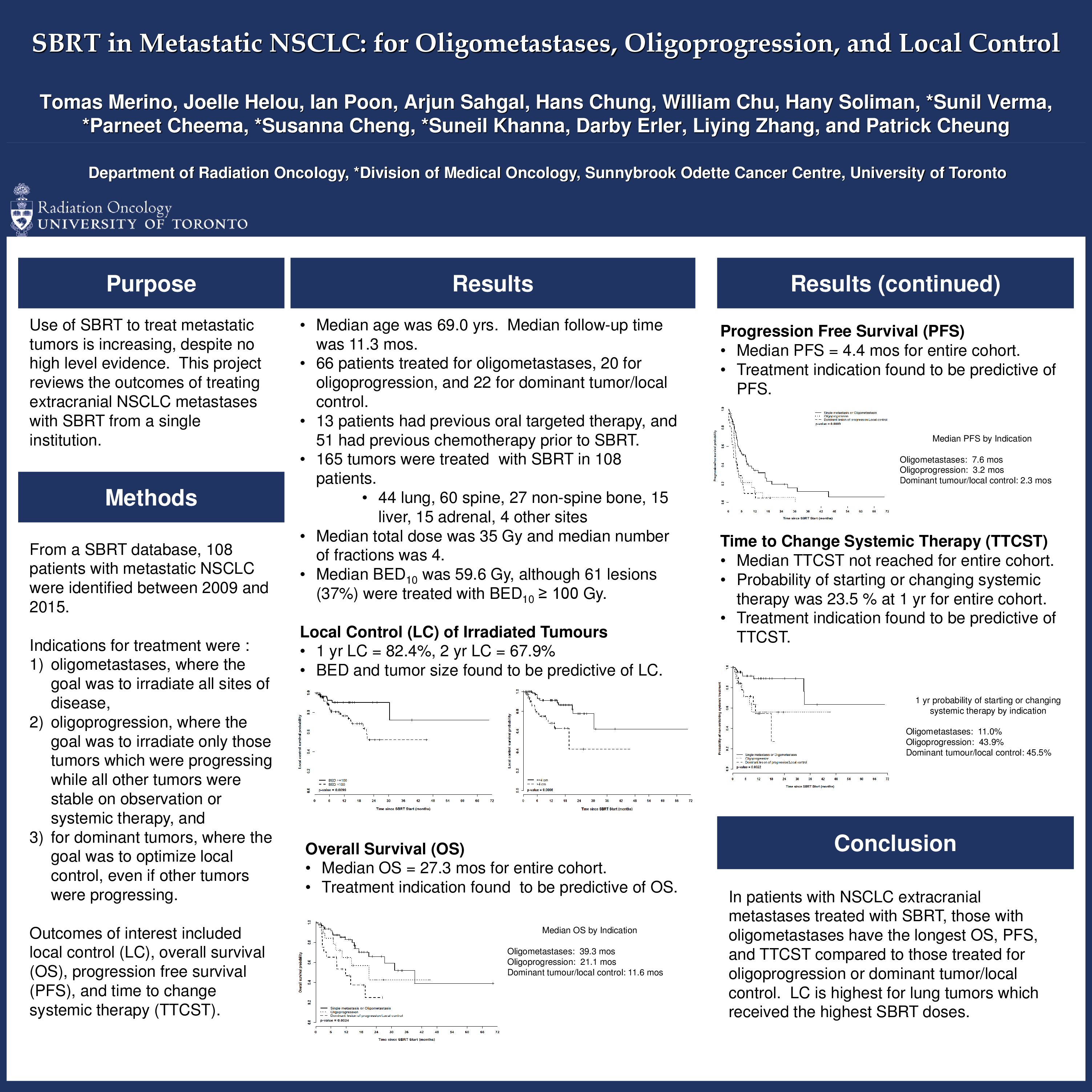
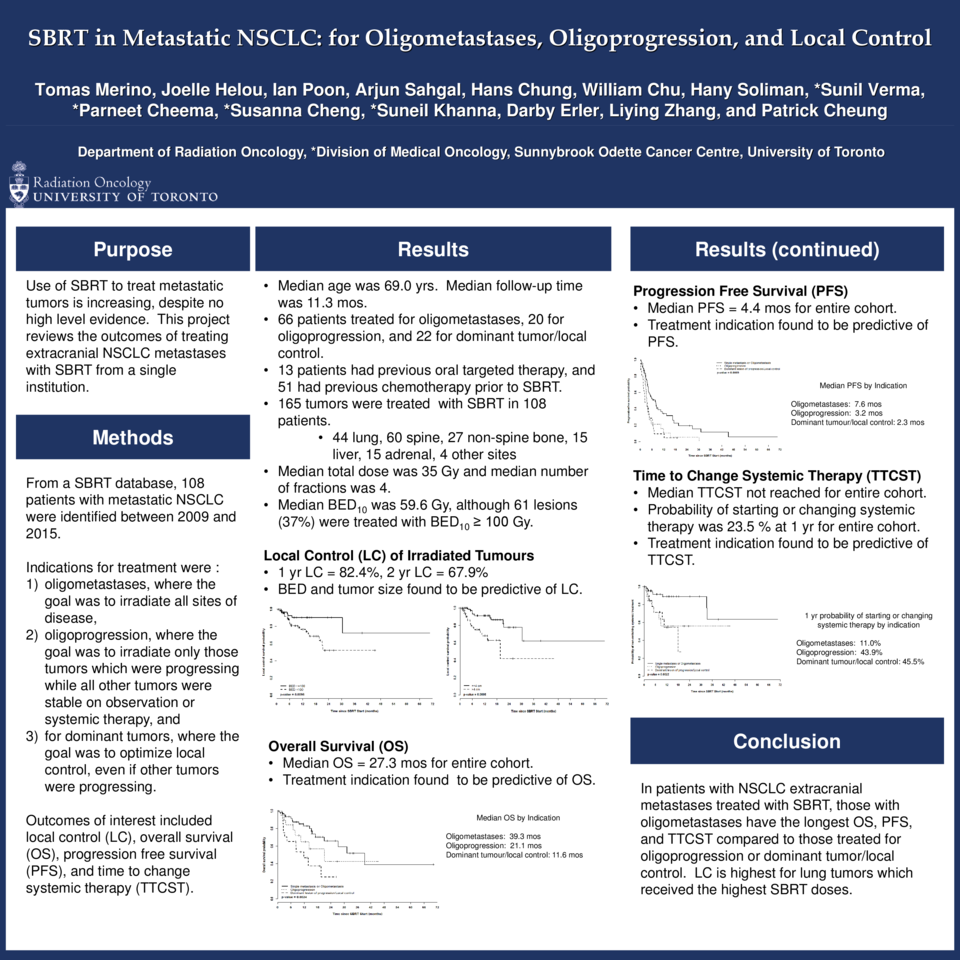
Purpose: Use of SBRT to treat metastatic tumors is increasing, despite no randomized evidence. This project reviews the outcomes of treating extracranial NSCLC metastases with SBRT from a single institution. Methods: 108 patients with metastatic NSCLC were treated between 2009 and 2015. Indications for treatment were 1) oligometastases, where the goal was to irradiate all tumor sites, 2) oligoprogression, where the goal was to irradiate only tumors which were progressing while all other tumors were stable on observation or systemic therapy, and 3) for dominant tumors, where the goal was to optimize local control, even if other tumors were progressing. Outcomes of interest were local control (LC), overall survival (OS), progression free survival (PFS), and time to change systemic therapy (TTCST). Results: Median age was 69.0 years. Median follow-up time was 11.3 months. 66 patients were treated for oligometastases, 20 for oligoprogression, and 22 for dominant tumour/local control. 13 patients had targeted oral therapy, and 51 had chemotherapy prior to SBRT. 11 were on systemic therapy (4 targeted oral therapy and 7 chemotherapy) at time of SBRT. A total of 165 lesions were treated (44 lung, 60 spine, 27 non-spine bone, 15 liver, 15 adrenal, 4 other sites). Median SBRT dose/fractions was 35 Gy/4 fractions. Median BED10 was 59.5 Gy, although 61 lesions (37%) were treated with BED10 of ≥ 100 Gy. LC at 1 year and 2 years was 80.2% and 64.4%, respectively. Univariate analyses revealed BED10 ≥ 100 Gy (p=0.0142), tumor size ≤ 4 cm (p=0.0012), and lung tumor (p=0.0421) to predict for higher LC. 2 year LC was 90.3% vs 52.1% for tumors treated with BED10 ≥ 100 Gy vs < 100 Gy. Median OS was 27.3 months. Indication for treatment independently predicted for OS (p=0.0045) with oligometastases patients living the longest, followed by oligoprogression, and then dominant tumor/local control (median OS of 39.3 months, 21.1 months, and 11.8 months, respectively). Median PFS was 4.4 months, with indication for treatment (p=0.0013) being independently predictive (median PFS of 7.6 months, 3.2 months, and 2.3 months for oligometastases, oligoprogression, and dominant tumor/local control, respectively). Median TTCST was not reached for the whole cohort. The probability of starting or changing systemic therapy was 23.5% at 1 year. Indication for treatment was predictive (p=0.0022), with the probability of changing systemic therapy strategy at 1 year being 11%, 43.9%, and 45.5% for patients treated for oligometastases, oligoprogression, and dominant tumor/local control, respectively. 17 patients (16%) received further SBRT at time of progression. Conclusion: In patients with NSCLC extracranial metastases treated with SBRT, those with oligometastases have the longest OS, PFS, and TTCST compared to those treated for oligoprogression or dominant tumor/local control. LC is highest for lung tumors which received the highest SBRT doses.